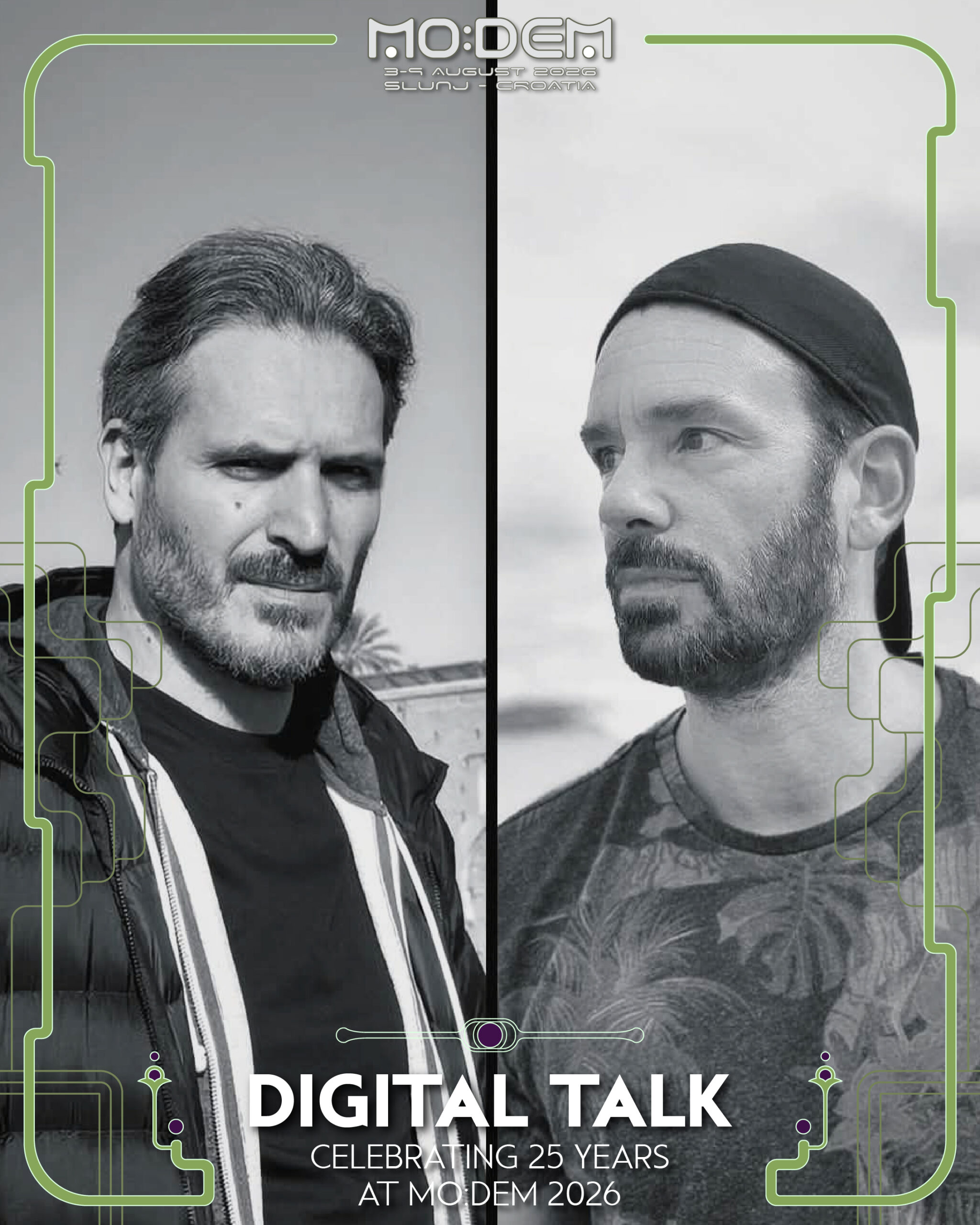
– Looking back over 25 years of creating music together as Digital Talk, what have been the most defining moments, challenges, breakthroughs, or lessons that shaped your journey as a duo?
Our musical collaboration really began 30 years ago with our previous project and collective of artists, Droidsect. During the late 90’s we were exploring new sonic territories and started pushing established boundaries. This naturally led us to build a bridge from Goa trance to something that would later be called darkpsy. This period laid the foundations for what would become Digital Talk when Droidsect came to an end in 2001.
At the time, it was quite challenging to promote such an unconventional sound. It wasn’t widely accepted, but we strongly believed in what we were doing and kept moving forward. The constant evolution within the scene gradually helped our message find its audience.
A major turning point was the recognition we received from Goa Gil. Throughout the early 2000’s, he regularly played our music in his legendary sets and even included some of our tracks on his mixed compilations. Having someone with such vision believe in our work was incredibly important.
The biggest lesson of our journey came in 2003, when we lost our entire debut album in a computer crash just 2 months before its release on Acidance Records. We lost not only the LP itself but also many unreleased tracks and all our sound design since 1998, including some of the last remaining Droidsect material.
Experiencing something like that teaches you humility. It reminds you that nothing is guaranteed and that years of work can disappear in an instant. We learned a lot about ourselves during that period, helped each other through this loss and stopped one another from giving up. In many ways, this experience strengthened both our human and artistic bonds for the years and the tracks to come.
Such events can unleash an unexpected creative force. In our case, it gave us the determination to start over and create what became the New Age Surf album in less than 9 months, an album that left a special mark at the time and perhaps still does today.
-Your sound has evolved while still holding a strong identity within the psychedelic spectrum. What continues to inspire your creativity today, and how has your relationship with music and collaboration changed over the years?
What probably kept our identity strong is the fact that we have always focused on telling stories through our tracks. It has naturally remained one of our top priorities. Above all, we love making music that can stand the test of time, music that we can still enjoy many years later.
At the same time, we never wanted to stay stuck in a specific genre. After 3 decades, that would have become boring. That’s why our sound has continuously evolved, from dark industrial psytrance in the late 90’s, to a groovier night sound in the 2000’s and eventually into a more twilight and fullonish direction in recent years. The reactions on the dancefloor definitely guided us naturally towards more dance-oriented rhythms.
Our inspiration comes from a wide musical spectrum. We grew up listening to psychedelic rock, acid jazz, hip-hop and many forms of acoustic, hybrid and electronic music from the 90’s. Beyond music itself, a large part of our inspiration comes from our life journey. Both the beautiful and the difficult moments shape our creativity. This is what allows us to express something honest and intimate through our music. Looking back, it seems that we have always been unconsciously searching for the next spark that will ignite our creativity.
As for our collaboration, we used to spend long periods working side by side in our studios, immersed in a creative bubble where nothing really existed except writing music and telling stories. Back then, almost nobody could interrupt our shamanic process except the postman ringing at the door.
Today, we live further apart and mostly work remotely by exchanging project files. However, if possible, we would like to return to a more physical way of composing. For us, being in the same room remains the most effective way to merge ideas and still be surprised by what emerges from the process.
-You have shared a long history with Mo:Dem and its community. What does the festival mean to you personally as Digital Talk, and what does it feel like to celebrate 25 years of your journey together as a duo within this unique gathering of people, sound, art, and shared experiences?
We wouldn’t say we share a long history with MoDem, simply because when the festival was born we were already taking a step back from the scene after a long and intense musical journey. However, what happened in 2024 created a very special connection between us and the festival.
We played there for the first time to present our live concept called 1996–2001: The Genesis of Darkpsy, dedicated to our former project Droidsect. We chose MoDem, and only MoDem, for this unique performance.
There was something very symbolic about presenting this material at MoDem. Back in the 90’s, when these tracks were written, there was no such thing as a darkpsy scene as we know it today but just underground parties in Europe or Goa. We were simply exploring new sonic territories and trying to push the boundaries of psychedelic trance in our own way. Seeing thousands of people connecting with this music decades later, at a festival that became one of the strongest place for this sound, felt like a complete circle. What moved us even more was seeing a younger generation enjoying this music with the same energy and passion that we had back then.
We could capture this epic moment on video, allowing us to relive it both visually and musically:
https://www.youtube.com/watch?v=3N-1OzUNwJg
Returning to MoDem this year to celebrate 25 years of Digital Talk feels quite surreal in many ways. Looking back, this project has accompanied us through a large part of our lives, with all its creative highs, lows, challenges and unexpected turns. To celebrate this milestone in a place that values artistic freedom and authenticity like MoDem feels ultra special. While this anniversary naturally invites us to look at the past, we are also super excited to also present our new material.
-Having witnessed the evolution of the psychedelic underground for more than two decades, what changes have you found most inspiring, and what values do you believe are essential for preserving the spirit of the culture moving forward?
From the beginning of the 90’s until the early 2000’s, we witnessed an exceptional period of evolution in electronic music as a whole. It was a time of incredible eclecticism, giving birth to unexpected creations, fusion of genres, strong identities and constant musical surprises. Even today that era remains one of our greatest sources of inspiration.
Over time, however, psytrance became divided into different categories. As this happened, much of the diversity that once existed within the scene slowly faded away, while a certain uniformity started to dominate each compartment. More than that, a lot of trance music became extremely mechanized, slowly losing part of its Dna and natural groove. This was one of the reasons why we eventually stepped back from the scene for a while. We simply couldn’t find enough creative fuel around us to keep moving forward, and to be honest, we also felt that we were starting to lock ourselves into our own formula.
In the past, electronic musicians would often spend countless hours playing with their synths and jamming in the studio. Today, most of the artists seem to spend more time editing audio than performing, and we can definitely hear it in the music, not only in psytrance by the way, but in electronic music in general. Fortunately, there are still inspiring musicians out there who are willing to take risks and explore new directions. We believe that taking risks, avoiding predictability and keeping a more human and organic way of creating music are essential to keep the culture true to its roots.
We also believe that the psychedelic scene needs more imagery, symbolism and mystery than individual personalities. The psychedelic rock scene of the past understood this perfectly, the focus was on the journey, the imagination and the worlds created through the music rather than on the people behind it. We don’t need stars, we just need to fly among them.
-As you mark this milestone and prepare to perform at Mo:Dem 2026, what message would you like to share with the next generation of artists and producers who are beginning their own journey?
More jams, less randomizers, more groove, less FM sounds, more parties and concerts from all genres to enrich your influences and creativity. 🙂
More seriously, we don’t think there is any secret formula. Everyone has to find their own way and their own voice. But if there is one thing we would encourage younger artists to do, it is to stay curious and avoid locking themselves inside a single musical universe. Sometimes the best ideas come from where you least expect them.
And above all, don’t hesitate to dive back into the origins of experimental psytrance and the alternative projects that helped open new doors at the time. Not because everything was better before, but because understanding where things come from can help you imagine where they could go next. Projects and artists such as Weirdo Beardo, Nick Taylor, Sinister Association, Tarante, Droidsect, Magus, Paps , to name a few, all helped expand the boundaries of what psychedelic trance could be.
The psychedelic movement has always been about exploration. So keep exploring, keep mixing things up and most importantly, keep surprising yourselves.