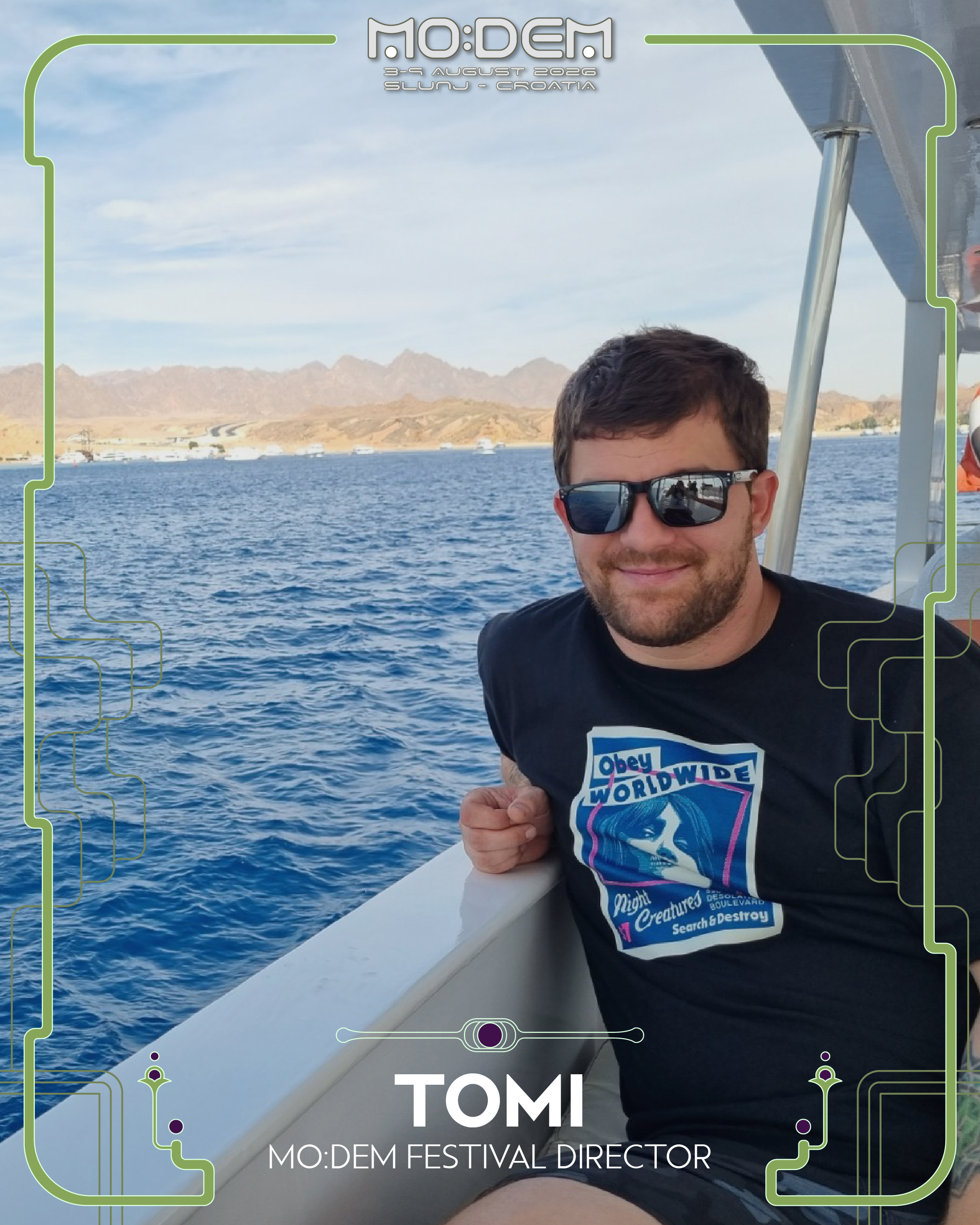
Tomislav Sijarto
Mo:Dem Festival Director
In conversation with Tomi, the director of Mo:Dem Festival. No filters, just a direct exchange about why Modem exists and where it is heading. Exposing the raw mechanics behind a festival that refuses compromise and continues to push psychedelic culture forward on its own terms:
1. Origins: How did Mo:Dem Festival come to life? Can you share the story behind its inception?
Modem Festival started as an expansion of parties I used to do in Zagreb Croatia. After doing parties for many years I always found myself stuck with ideas that were not achievable for one-night parties and projects that were way out of the budget limits that a day/night party can cover. The other reason is the music. What is now a style of music that is widely represented on stages across the globe in the early years of Modem that music was still considered taboo / too dark / too experimental and pretty underground. After going to many festivals despite loving the festival feeling and vibes I never found myself satisfied with the actual music selection. And besides a few festivals even today I find that festivals are mostly catering for a spectrum of people that I find too wide.
So the main idea and concept of Modem was to bring underground music a bit closer to the surface and give it a respectable platform by ticking all the boxes in terms of event production quality.
2. Vision: What is the core vision and philosophy behind Mo:Dem Festival?
Cutting-edge music accompanied by cutting-edge art and visuals to create an ultimate psychedelic experience like no other place 🙂
3. Personal Journey: What inspired you personally to get involved in organizing this festival?
Well despite going to many many festivals before I started Modem I was personally never happy with the music selection of the majority of the events I attended. Even if all is classified as a psytrance genre I do not like fluffy sounds, cheesy sounds progressive or any melodic trance. Unfortunately even today many events are trying to cater for too many people at the same time. I find it problematic if I have to keep looking at the timetable and almost run a diary to hear some good music that suits me. On Modem the idea is to cater for a much smaller group of people that are more focused on deep psychedelic and dark sounds regardless of BPM (Swamp caters for the same style of music just slower BPMs). And I think the formula is working as we have many visitors that come almost every year to Modem as the only festival they visit.
4. Challenges: What have been some of the biggest challenges you’ve faced while organizing Mo:Dem?
In the first years lack of experience in building and site management. Challenges that are still ongoing forces of nature.
We had all kinds of weather and catastrophic events in the last 12 years of Modem. From fire that burned and literally took the whole inventory Modem had (in 2018) to destructive floods that now with climate change happen on a regular basis. In 2019 after almost finalising work on the Swamp stage overnight water rose by 2 m and basically took everything we built for 2 months leaving us in deep trouble and massive financial problems.
5. Overcoming Obstacles: How have you and your team overcome these hurdles?
By adding a few hundred extra hours of work 😀
7. Milestones: What are some of the proudest moments or milestones in Mo:Dem’s history?
The biggest milestone in Modem’s history is actually coming to the point that production is running so smoothly during the event that me and the pre-production team can take some days off and actually enjoy the event the same as visitors. There is nothing more rewarding than enjoying the event stress-free after months and months of staying on site and building.
7. Evolution: How has Mo:Dem evolved over the years both musically and culturally?
Well Modem together with the crew (that is constantly changing) did evolve radically in the last 13 years. Throughout the years more and more people got involved and a lot of experts in certain crafts joined the team and created a good hub of creative minds. Together we try to think outside the box and do a different approach to art visuals and music selection.
With higher and stable attendance we managed to precise the investments on festival grounds and expand the dancefloors so now we have three respectable-sized dancefloors that can cater to a wide range of music on decent sound systems and stage designs.
8. Community: How do you see the role of community in the festival’s success?
Our community helped a lot that is for sure. Without such a great crowd and loyal visitors that are visiting the festival every year we wouldn’t be able to reach the point we are at now.
9. Music: What are the parameters of selection of the kind of music that plays at Modem and how has it shaped the festival’s atmosphere and identity?
One common denominator is psychedelic. The music we play must have a tone of psychedelic heavy beats. No fluff, no cheesy melodies.
10. Art and Creativity: How and why is art and creativity important in the festival experience? How did the Modem style come along and what is that signature to you?
At Modem without any hesitation I do believe we did kind of a revolution on the festival scene regarding art and deco. When we started we were one of the pioneers in projection mapping usage of CNC machines for stage crafting and in general distribution of budget more towards art less towards headliners. Now most festivals have projection mapping on the stage and in general it has become a norm to invest money in the visual aspect of the festival. Most of our money, time and effort is going into art direction much more than into the lineup.
12. Team: Can you tell us about the team behind Mo:Dem its evolution and how you all collaborate?
Modem team is a constantly changing group of creative hard-working people that are passionate about their work. Throughout 14 years a lot of new people came in and a lot of old people left but the one thing that keeps us all connected and on the same page is a passion for the project. The duration of the festival production is incredibly long (we usually start as soon as weather allows in early spring) so we are forced to live and operate as a family or a community.
13. Future: What are your future plans and aspirations for Mo:Dem Festival?
We are currently busy curating and planning the new Hive stage. Due to the complexity, size and sheer magnitude of the project we want to do we are taking two years’ time to make the whole thing work. This is the project that most of the team is fully preoccupied with now and will be until we present it at Modem 2027. At one point we realised that certain projects are just not achievable from one festival to another so the new strategy allows us to have bigger budgets and more time to design, plan and troubleshoot projects that have to be bigger, better and more impressive than the previous ones.
15. Personal Insights: How has organizing Mo:Dem impacted you personally and professionally?
Well Modem is like my child, a brilliant but also problematic one that gives you lots of headaches and worries. It forced me to develop in directions I never even thought I would go to and forced me to learn skills I never thought I would need in my life. It is also an extremely time-consuming and addictive hobby. A love-and-hate relationship depending on the time of the day or hour. It can be draining but incredibly rewarding seeing the result. When all clicks together when the music starts even if every single member threatens to quit or goes crazy the moment the music starts it’s all worth it. I honestly cannot imagine my life without Modem regardless of it being a heavy burden sometimes.
15. Can you tell me about the Backstage platform customised for Modem?
After all these years, production that lasts four months also requires an incredible amount of information and data for everything to run smoothly. Without internet connectivity in the first years and in general really bad signal all around the venue we were forced to develop software that is tailored to our needs regarding ticket sales staff management and all the other information we need in real time. For example at Modem just for the crew we serve over 20,000 meals in one year of production. That alone was bringing a massive headache to our kitchen department. Halal vegetarian gluten-free vegan food intolerances allergies all that had to be taken into consideration. With Backstage as a program we have managed to put all the data for gates, kitchen, arrivals, departures and other valuable info into one platform that makes our life easier 🙂